





Translating your website is not an act of international vanity. For a shop twenty minutes from a border, for a hotel that lives off tourism, for a workshop that ships abroad, it is often the cheapest growth lever available — provided it is done properly.
Who actually needs one
Let us start with the opposite, because it is more honest: a plumber working around Chartres has no need whatsoever for a multilingual website. Their money is better spent on their town pages and their customer reviews. Translation does not create a market: it opens the door to a market that already exists and that you cannot see.
Shops and trades in border areas
This is the most obvious case and the most under-used. A joiner in Thionville, a dentist in Menton, an optician in Perpignan: their potential customers live fifteen minutes away by road and search in German, Italian or Spanish. Those customers will never find your site, not because it is bad, but because they do not phrase their search in your language. One well-built German page puts you on queries where, until now, you had no local competitor at all.
Tourism and accommodation
Guest houses, hotels, restaurants, outdoor activities: your customers plan their stay from home, often months ahead, and in their own language. At the moment they search for “traditional restaurant + the name of your village”, they do it in English or in Dutch. A website in a single language leaves you unreachable throughout the decision phase — precisely the phase where the budget is set.
E-commerce that ships abroad
If you already deliver outside your own country, your analytics hold the answer: a marked gap between traffic coming from abroad and orders from abroad points to a language problem, rarely a price problem. A visitor who does not understand your returns policy or your delivery times does not buy — and will not even write to ask.
Why a visitor buys more in their own language
It is not only a matter of comprehension: many of your foreign visitors would understand your page as it stands, with a little effort. The problem lies elsewhere — buying is an act of trust, and trust is settled in the details.
Reading in a foreign language imposes a constant mental load. And the decisive moments of a purchase are exactly the ones where you read twice: warranty terms, shipping costs, the cooling-off period, the order form. A visitor who hesitates over the precise meaning of a sentence does not take the risk — they close the tab. They will never tell you why, and all you will see is one more visit that came to nothing.
On top of that comes a far simpler signal: a translated site says “we already have customers like you”. A site in one language says the opposite. For a trade near a border, that is sometimes the whole difference between a quote requested and a quote never considered.
What a real multilingual website demands
This is where a great many projects come off the rails. A multilingual website is not your website with a drop-down of flags on top. Four technical requirements are non-negotiable; if one is missing, Google will not know which version to show to whom, and the benefit evaporates.
A distinct URL for each language
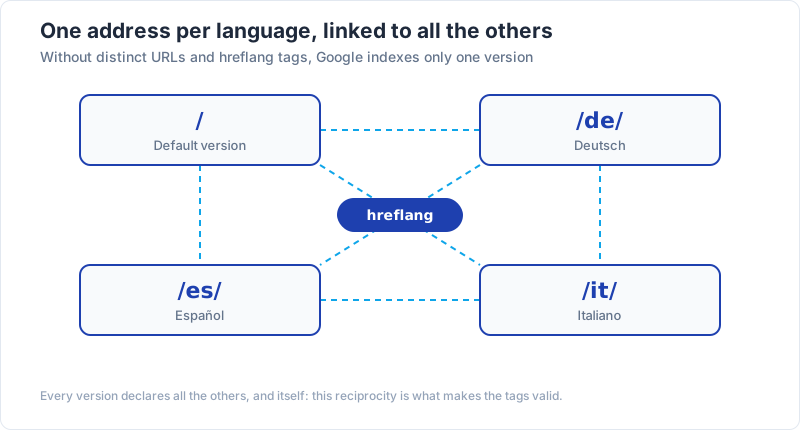
Each language must live at its own address: /de/ for German, /es/ for Spanish, /it/ for Italian. A page that changes language without changing URL — through a JavaScript button, say — is indexed once, in one language: every translation stays invisible to search engines. This is the most common and the most expensive mistake, because it gives the illusion of work done.
The hreflang tags
The hreflang tags tell Google, for each page, the list of its equivalents in the other languages. Without them, your versions compete against one another: the engine may serve the Spanish page to a German visitor, or treat two translations as duplicate content. These tags must be reciprocal — every version declares all the others, including itself — and must name a default version for visitors no language covers.
The whole interface, not just the paragraphs
This is the part people discover too late. Translating a site is not translating its text: it is translating the menu, the breadcrumb, the form labels, the error messages, the submit button, the thank-you page, the legal notices, the alternative text on images, the title and description of every page. A site with half its interface still in the original language produces the opposite of the intended effect: the visitor sees they are on a bodged version and, if they have to hand over their phone number, they think better of it.
A sitemap that declares every language
Finally, the sitemap must list every URL in every language, with their correspondences. That is what lets Google discover your foreign versions without waiting for an external link to point them out, which can take months. On the sites we build, this file is regenerated on every deployment: one of the advantages of a static site architecture, where each page really does exist as a file.
The machine translation trap
Machine translation engines have become excellent. The problem is not their average linguistic quality: it is that they fail precisely where your credibility is at stake.
They translate trade vocabulary badly — a “dripping leak”, a “firm and final quote” come out as approximations a local professional spots within a sentence. They ignore local legal obligations, which are not translated but rewritten. They produce turns of phrase that are grammatically correct yet do not ring true: a native reader will not be able to name what is wrong, but they will feel it, and the doubt is enough to make them leave the page.
The most damaging of all is the widget that translates on the fly, inside the browser: the translated content does not exist on the server, so it is neither indexed nor ranked. You pay a subscription for reading comfort without gaining a single extra visitor. A human translation, checked by someone who knows the trade, is paid for once and pays back for years.
Accents and typography: the detail that destroys credibility
There is an instant way to lose a foreign visitor: render their language badly on screen. A German ß replaced by “ss” in a heading, a Polish ł turned into “l”, a Portuguese ç flattened to “c”, strings of “é” where the accents should be because the file's encoding is not UTF-8 — the native reader sees it before having read the sentence. And draws the obvious conclusion: this site was not made for them.
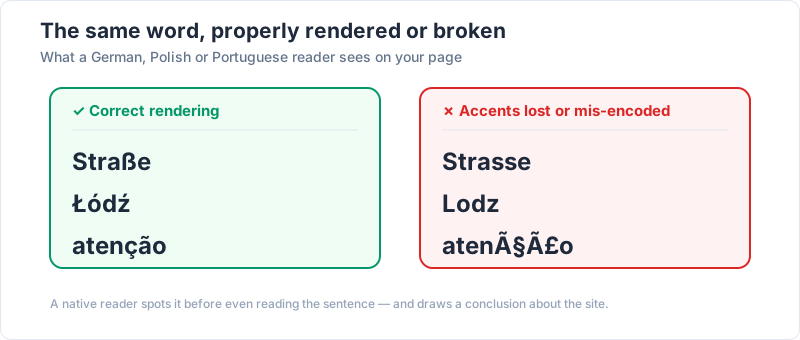
These details cost little to respect and a great deal to neglect. They require three things: correct encoding, fonts that genuinely contain the characters of each language, and a final proofread language by language. We ran exactly that check across the eight languages of this very site: it still turned up badly rendered characters, in the places nobody thinks to proofread — button labels, error messages, image attributes.
What it costs, and when it pays for itself
At Web Pulse, translation is an option at 300 EUR excl. VAT per additional language, with ten languages available. The price covers the full translation of the interface, not just the body text: navigation, forms, buttons, legal pages. The details are on our pricing page, along with the other options.
The return calculation is direct: ask yourself what an average customer is worth to you. For a hotel it is a stay; for a joiner near a border, a fitted kitchen; for an online shop, a handful of orders. In most of the trades we work with, a single extra job covers the investment — and the translated version works every day.
Finally, remember that each language replays the local search battle from the start, with its own competitors, usually far fewer of them. It is the natural extension of what we explain in our article on local SEO and how to rank first in your city: the same rules, on far emptier ground.
What to take away
A multilingual website is only useful if a foreign clientele already exists within your reach: a border, tourism, shipping abroad. In that case it is not a coat of paint but a second shopfront, with its own URLs, its own tags and its own linguistic credibility. Done by halves, it returns nothing. Done properly, it is often the cheapest square metre of shop window you will buy this year.
Do your customers speak another language?
Tell us where you are based and where your customers come from: we will tell you plainly whether a translated version makes sense in your case, and which language to start with. Website creation is free, with no commitment.
Discuss my multilingual project