







In a small town, almost any professional can show up in Google's first three results. In a large city, those same three places are fought over by dozens of competitors — and they are not handed out at random.
The local pack is where everything is decided
When someone searches for “plumber in Melun” or “lawyer in Nantes”, Google shows a map first, then three business listings. That block of three — the local pack, which we will call the podium here — captures the bulk of the calls. The results below it exist, but they are rarely read: the customer rings one of the three and the job is settled before they have scrolled the page.
So the whole of local SEO comes down to a simple question: what decides those three places? And the answer, counter-intuitively, depends first of all on the size of your town.
What we measured across 899 French towns and cities
In September 2026 we recorded the positions Google Maps displayed in 899 French municipalities, across a wide range of trades, cross-referencing every result with the population of the municipality. The figures below come from French towns — but the mechanism behind them is not French, it is simply how Google ranks local results. We call a “small town” a municipality of fewer than 20,000 inhabitants, and a “large city” one of 100,000 and over. A handful of figures sums up what we saw.
In a large city, the website does the sorting
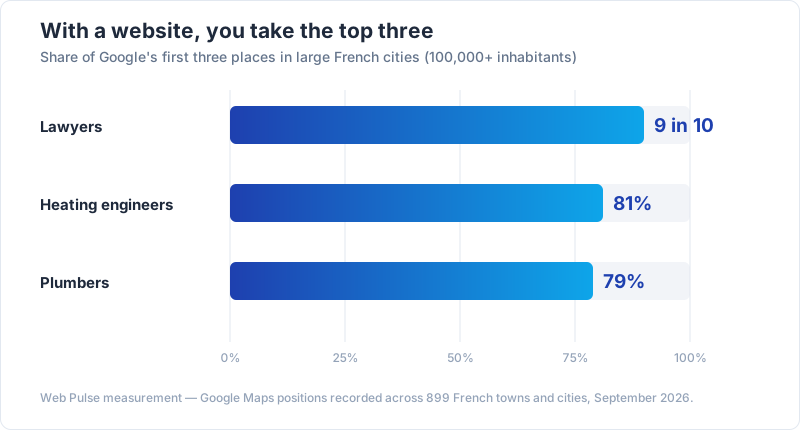
Among lawyers in large cities, nine podium places out of ten go to a firm that has its own website. Among the trades the picture is much the same: a plumber or a heating engineer with a website of their own holds roughly three podium places out of four.
Removal companies make the point more brutally. In large cities, nineteen removal firms in a hundred have no website — and between them, they take fewer than one podium place in a hundred. They exist, they work, their listing is filled in. They are simply invisible at the exact moment the customer chooses.
In a small town, the penalty is mild — and that is the trap
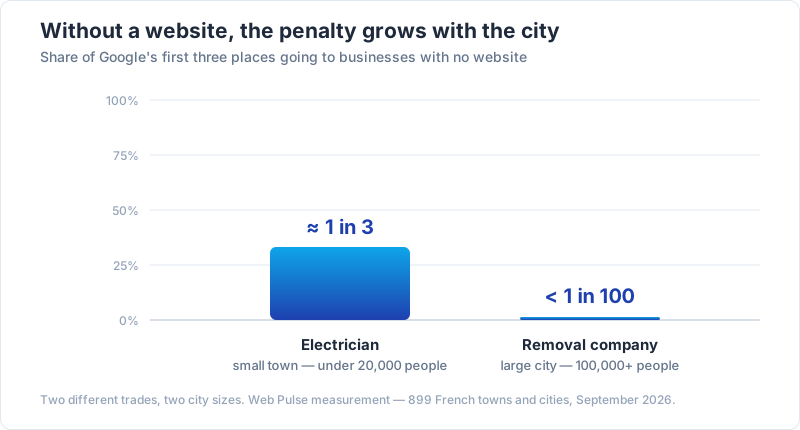
Change the scale and the picture almost reverses. In small towns, an electrician with no website still holds the podium in proportion to their numbers: they make up about a third of the town's electricians, and they hold about a third of the places. Having no website costs them almost nothing.
That is precisely what makes the situation dangerous: the penalty grows with the size of the town. As long as you work in your own village, the missing website does not show. The day you go after the larger town next door, the door has already closed without a sound — and you will never know how many calls you did not get.
Why Google ends up here
There is nothing mysterious about the mechanism. In a municipality of 8,000 people there may be six plumbers: Google has no need to split hairs, geographical proximity decides almost everything. In a large city there are a hundred and fifty within a ten-minute drive. Proximity no longer separates anyone: other criteria are needed, and that is where the gaps open up.
Those criteria are trust signals: information Google can verify somewhere other than on the listing itself. A website attached to the listing is the first of them, because it confirms what the listing claims — the address, the phone number, the opening hours, the actual services, the area covered. A listing on its own is a statement. A listing backed by a consistent website is a verified statement.
That is why a website does not replace a Google listing, and why a listing never replaces a website: the two validate one another. It is also why we build every local website town by town, rather than one catch-all shopfront meant to cover a whole region.
The seven levers, in the order to tackle them
1. A complete, living Google Business Profile
Fill in absolutely everything: regular and holiday opening hours, description, services, area served, payment methods, link to the website. A profile completed to 100% is not treated like a half-empty one. Then post regularly — photos from a job, a new service, summer closing dates: a Google Business Profile with no sign of life for eight months signals a business that has gone to sleep.
2. The primary category: one choice, and it decides
This is the most underrated setting of all. Your primary category determines the only searches you are eligible for. A heating engineer filed under “plumber” is fighting on the wrong ground and loses the queries that actually concern them. Pick the category that describes the core of your trade, then add secondary categories for the rest of your work. And do not change it every month: each change takes several weeks to settle.
3. Reviews — and above all your replies
Volume counts, regularity counts more: ten customer reviews spread over the year are worth more than thirty collected in a single week, which look like a campaign. Reply to every review, and above all to the bad ones. A calm, factual reply that acknowledges the problem and offers a solution reassures far more than a perfect average: the reader sees how you behave when things go wrong. Ask for the review while the job is fresh, not three weeks later.
4. NAP consistency (name, address, phone)
NAP, for name, address, phone. These three pieces of information must be written identically everywhere: Google listing, website, trade directories, social media, your partners' pages. “12 High St.” in one place and “12 High Street” in another, a mobile number on the site and a landline on the listing: every discrepancy weakens the link between the two. List every place your business is mentioned, then bring them into line, character by character.
5. One page per town — a real one
If you cover twelve towns, you need twelve local pages, one per town. But a town page is only worth something if it is genuinely different from the other eleven: the neighbourhoods served, response times, jobs actually done there, the quirks of the local building stock. Twelve identical pages where only the town name changes fool nobody any more, and duplicate content ends up costing you positions. Our portfolio shows what genuinely distinct local pages look like.
6. LocalBusiness structured data
Structured data is a block of code invisible to the visitor, describing your business in a format search engines read without ambiguity: type of activity, address, GPS coordinates, opening hours, average rating, area served. The LocalBusiness markup is the version made for local businesses. It is not a developer's toy: it is what lets Google cross-check your website and your listing without having to interpret your page layout.
7. Geotagged photos
Post real photographs: your jobs, your workshop, your van, your shopfront — never stock images. Taken on a phone with location switched on, they carry GPS coordinates that confirm where you actually are. And above all they get looked at: on many listings, photos are the last thing viewed before the call.
Where to start
If you are starting from nothing, the order is simple. The listing first, because it is free and immediate. The website next, because that is what will carry you over the threshold when your market widens. Reviews continuously, because that is the one lever nobody can build for you. The rest — page structure, performance, structured data — is execution, and it is settled once and for all.
One last point, if your customers cross a border or come as tourists: the whole of this machinery plays out again language by language, with its own podiums and its own competitors. That is the subject of our article on the multilingual website and its effect on revenue.
What to take away
Your place on the local podium does not depend on how long you have been trading or on how good your work is — Google knows neither. It depends on what it can verify: a complete listing, a consistent website confirming it, steady reviews, identical information everywhere. And the bigger your town, the less optional any of that becomes.
Want to know where you stand?
We look at your listing, your competitors and your real position in your own town, then tell you plainly what you are missing. Building the site is free, with no commitment: you only pay if you keep it.
Request my free local review