







The question comes up at almost every first meeting: "do you build in WordPress?" Behind it is a business owner who has heard two opposing pitches and simply wants to know which one will cost the least money, the least time and the least trouble. Let us answer honestly, without taking sides.
We are asking the wrong question
Setting WordPress against static sites as if they were two car brands makes no sense. A plumber who wants to be called by residents of three neighbouring towns and a clothing label shipping two hundred parcels a week are not in the same business, so there is no reason for them to have the same website.
The real question is not "which technology is best", but "what will my site actually have to do, and who will look after it eighteen months from now".
Two ways to build a web page
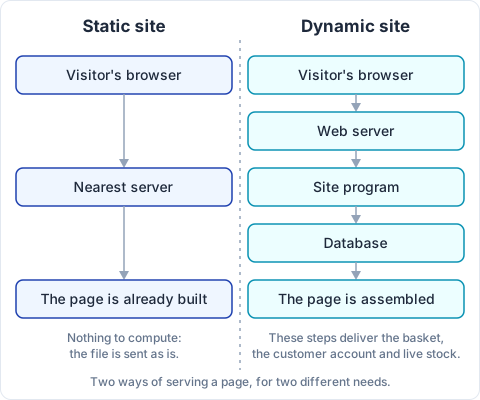
WordPress is a CMS, a content management system. Your words and images live in a database. On every visit, the server queries that database, assembles the requested page and sends it to the visitor. That is exactly what makes WordPress so flexible: because the page is rebuilt on demand, it can adapt to the visitor and show a basket, a customer account or live stock levels.
A static site works the other way round. Pages are assembled once, when they are published, and stored as finished files. When a visitor arrives, the server has nothing to work out: it simply hands over the file.
What WordPress does better than anyone
Let us start here, because it is often left unsaid by people selling something else. WordPress powers a substantial share of the web, and that is no accident — we maintain WordPress sites ourselves for clients, with our eyes open.
Selling online
This is the clearest case of all. As soon as you have products, stock, promotions, couriers, invoices and abandoned-basket reminders, WordPress and its e-commerce extension give you in a few hours what would take weeks to rebuild elsewhere. If your project is a shop, start with our guide to launching an online store, where we go through that choice in detail.
Publishing without depending on anyone
Someone on your team wants to add a news item on a Friday at five o'clock. With WordPress, that person logs in and does it. The interface is familiar to millions of people, and you can find a trainer or a troubleshooter in any town. That editorial independence is a serious argument, especially where several people contribute to the site.
The plugin that already exists
Appointment booking, membership management, forums, member areas, ticketing, classified ads, online courses: for almost anything, there is a mature plugin already tested by tens of thousands of sites. Getting years of development for a few tens of euros a year is an excellent deal — and a perfectly sound reason to choose WordPress.
An editorial team and a busy blog
Several writers, different roles, a draft reviewed before publication, a revision history, articles going out every week: this is precisely what WordPress was built for in the first place. On that ground it remains hard to beat.
What a static site does better
Speed, by design
A static site has nothing to calculate and no database to query. The file leaves from the nearest server and appears almost instantly. This is not an optimisation you bolt on: it is the nature of the technology. And loading speed weighs on both your search rankings and the number of visitors who give up before your page appears.
Fewer moving parts to watch
Let us be precise here, because a great deal of nonsense is written about it. The WordPress core is solid and its security team does serious work. The trouble comes from plugins abandoned by their authors and from updates put off month after month. A well-maintained site does not get hacked; a site left untouched for two years does. A static site has no database and no administration page exposed to the internet, so it simply offers nothing to grab hold of. That is less a technical victory than a difference in how much surface you leave exposed.
A local site across many towns
If you cover thirty towns, you need thirty genuinely useful pages, not thirty copies of the same text. A static site generates those pages from a single template fed by your local data, and publishes them in one go. That is the logic behind our website creation pages by town, and it is an exercise where WordPress takes considerably more work for a slower result.
The high-end showcase site
When a site has to convince within three seconds — a restaurant, a consultancy, a craftsman who cares about image — every detail counts: typography, restrained animation, properly sized images, controlled page weight. Static gives you full control over that finish. Our recent work gives a concrete idea of the standard you can reach.
The match-up, criterion by criterion
| Criterion | WordPress | Static site |
|---|---|---|
| Loading speed | Good, provided the site is well built and well hosted | Excellent with no particular effort |
| Publishing an article yourself | Immediate, with a familiar interface | Possible, but needs a dedicated tool or a supplier |
| Selling online | Mature ecosystem, complete, ready to go | Possible, but every piece has to be built |
| Business features (booking, membership…) | A plugin almost always exists | Bespoke development |
| Maintenance | Regular updates you cannot let slide | Next to none |
| Exposed surface | An online admin area to protect | No admin area exposed at all |
| Hosting | A server to size against your traffic | Very light, distributed worldwide |
| Dozens of local pages | Feasible, but heavy to maintain | Generated from a single template |
| Finding someone to take the site over | Very easy, in any town | Narrower pool, more technical profiles |
No column wins everywhere: that is precisely the point of this article.
The real cost over three years
Comparing build quotes is misleading. What matters is the total after three years: the build, the domain name, hosting, paid plugins renewed every year, maintenance and the call-outs when something breaks.
WordPress has a low entry ticket and a recurring upkeep cost: theme and plugins to renew, updates to apply, backups to check. Static reverses the load: hosting becomes almost free and maintenance next to nothing, but every substantive change goes through someone. At Web Pulse we chose to make that calculation readable: the build is free, activation costs 500 EUR excl. VAT if you are happy with the site, and everything else is included in a monthly subscription. The detail is on our pricing page, with no minimum term.
Five questions to settle it in ten minutes
- Do you sell products online? If so, WordPress starts with a considerable head start.
- Who will publish, and how often? Someone in-house, every week? WordPress. A few updates a year? Static is plenty.
- Do you need a specific business feature? Booking, member area, ticketing: check first whether a plugin already covers it.
- Is your site above all a showcase? If its job is to convince and trigger a phone call, static is built for that.
- Who will handle updates eighteen months from now? If the honest answer is "nobody", do not choose a tool that demands them.
What if the right answer were "both"?
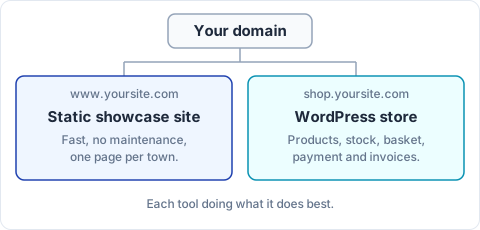
It happens often, and it is frequently the smartest option. A fast static showcase site to present the business and capture enquiries, and a WordPress store on a subdomain for the selling. Each tool does what it is good at, and you only pay for complexity where it genuinely earns its keep.
In short
Choose WordPress if you sell online, if you publish often in-house, or if you need a business feature a plugin already covers. Choose a static site if your site is a showcase, if it has to be faultless in speed and finish, if it spans several towns, or if nobody at your company wants to hear about maintenance.
In both cases the worst choice is the same: a site you install, forget, and rediscover three years later, slow and dated.
Still unsure which way to go?
Describe your business in a few lines. We will tell you plainly which solution suits your case — including when it is not ours.
Ask us, free of charge